Search This Blog

Friday, May 21, 2021

City of Al- Rafiqa , Syria - Islamic Arts And Architecture


Baghdad was not the only city founded by Caliph Al-Mansur. He also developed a site in northern Syria on the east bank of the Euphrates River. The area had been settled in classical times, but in 772, as part of the program of border Extention, Al- Mansur founded a settlement known as al-Rafiqa.

Al-Rafiqa was modeled after the round city of Baghdad, and the surviving fortifications confirm this statement. Al- Mansur commissioned his son and successor  Al-Mahdi to oversee the construction of this city. Later additions such as outer walls were carried under Al-Mahdi son Harun ur Rashid. The place served as a garrison town for his Khorasanian Persian army on the border with Byzantine Empire to protect Abassids Territories. it was also suited at the crossroads of important caravan routes at the confluence of the river Euphrates with the river Khabur.

https://go.fiverr.com/visit/?bta=876286&brand=fiverrcpa&landingPage=https%3A%2F%2Fwww.fiverr.com%2Fsearch%2Fgigs%3Fquery%3Dcontent%2520creator%26source%3Dtop-bar%26ref_ctx_id%3D93ac3a38288333bf223b665334e686d2%26search_in%3Deverywhere%26search-autocomplete-original-term%3Dcontent%2520creator

In plan, Al-Rafiqa consists of a closed horseshoe-shaped area 1.3 km wide. It was protected by a massive wall, nearly 5 km long and fortified by 132 defensive round towers, as well as an outer wall and a moat. 3 gates led to the interior, the small western gate, the bulky northern gate, and the gate located on the southeastern corner of the city wall known as Baghdad gate, In the center of La-Rafiqa stood a large Friday Mosque, built to serve the garrison of soldiers from Khorasan. Its massive mud bricks wall were faced with baked brick. The interior courtyard was surrounded by hypostyle halls carried on brick piers. The prayer hall on the Qibla side was 3 bays deep, while those on the other3 side of the court were only 2 bays deep.

Raqqa, together with al-Rafiqa, formed the largest urban entity in Syria. It is hardly surprising, therefore, that Harun al-Rashid, who disliked Baghdad, transferred his residence there in 796, and it remained his base until 808. During his 12 years of residence, he not only added to the city's fortifications but also constructed an impressive palace quarter to the north. Covering almost 10 square km, it included 20 large palace complexes. The largest of them, set in the center, measured about 1150x980 feet. it can be identified with Harun's residence.

Stay Connected for more. Thank you!


Monday, April 12, 2021

Architectural Features and Influences of Umayyad - Arts and Architecture

 Materials :

Umayyad architecture represents the birth of the first Islamic architecture tradition, one that adapted features from the Sassanian and Byzantine empires.
The Umayyad's used stone extensively in their architecture as this material is abundant in great Syri, where most of their surviving buildings are located.


Architectural features of Umayyads

They used stone in their architecture as this material


Brick is also used frequently, often in the combination with stone.


Mosaics are used widely as a surface cover for both floors and walls.

Architectural Features of Umayyad

Mosaics are used widely in Umayad's Architecture


Stucco is used as a decorative material and becoming particularly widespread during the later Umayyad period.

Architectural Features of Umayyad

Stucco is used as a decorative material 


Wood is used as a construction material for roofs and domes, and also as a decorative material for elements such as doors and panels.

Architectural features of Umayyad

Wood is used as a construction material


Reused Roman and Byzantine elements, such as column shafts and capitals, are commonly incorporated into Umayyad buildings.

Architectural Features :

In general terms, Islamic Architecture can be classified into two categories:
Religious Architecture
Secular Architecture.

Religious Architecture :

Mosques :

The Mosque for obvious reason lies at the very heart of Islamic Architecture. It is a symbol of faith.
The symbolic role was understood by Muslims at a very early stage and played an important part in the creation.
The First Mosque in Islam was the courtyard of the Prophet's house in Madina, with no architectural features.
Early Mosques built by Muslum as their empire was expanding were simple.
The general plan consists of a large courtyard by arched porticoes, with more aisles or arcades on the side facing Mecca / Qibla.
The great mosque of Damsusc followed the same plan of the Prophet PBUH mosque and became the prototype of many mosques built in various parts of the Islamic world.
The minaret, mihrab, and minbar make their first appearance in the religious architecture of the period.
The arch in Umayyad architecture is primarily round in shape, which becomes predominant in later periods.
 

Secular Architecture :

Whereas the functions of the religious buildings of early Islam could not have existed without the new faith, the functions of secular Muslim architecture have a priori no specifically Islamic character.

stay connected for more informative blogs.
 

Wednesday, February 10, 2021

Academic Achievements of Abassids


Abu Jafar Al-Mansur, the second Abbasid Caliph, was a very learned person of his time who showed great interest in the development of scientific learning. The famous scholar of his age was Imam Abu Hanifa, Ibn Ishaq, Imam Malik, Abu Amr Abd Al-Rehman Ibn Amr, And Sufyan Al-Thawri. The most popular scholar of his time was Abdullah Ibn Muqaffa.

Under the Abbasids, higher education in science was carried out on an individual basis rather than the establishment of institutions of higher learning. Afterward, they Sponsered observatories and hospitals in different parts of the caliphate. Most of the scholars were celebrated for their standing in different disciplines and their achievements in more than one science. Within a short time Muslim philosophers, mathematicians, physicians, geographers, alchemists, botanists had worked throughout the caliphate and achieved the amazing accomplishment of uncovering the vast intellectual heritage received from the earlier civilizations.

The 5th caliph of the Abbasid Dynasty, Harun al-Rashid is remembered as one of history's greatest patrons of the arts and sciences. Under his rule, Baghdad became the world's most important center of science, philosophy, medicine, and education. The massive size of the caliphate meant that it had contact and shared borders with many distant empires, so scholars at Baghdad could collect, translate and expand upon the knowledge of the other civilizations, such as the Egyptians, Persians, Indians, Chinese, Greeks, Romans, and Byzantines.

The successors of Harun al- Rashid, especially his son al- Ma'mun continued his policies of supporting artists, scientists, and scholars. Al- Mamun founded the Bayt al Hikma, the house of wisdom in Baghdad. At the house of wisdom, important ideas from around the world came together. The introduction of Indian numerals, which have become standard in Islamic and Western worlds, greatly aided in mathematics and scientific discovery.

Scholars such as Al- Kindi revolutionized mathematics and synthesized Greek philosophy with Islamic thought. Al- Biruni and Abu Nasar Mansur among many other scholars made important contributions to geometry and astronomy. Ibn Musa, expanding upon Greek mathematical concepts, developed Algebra which is derived from his landmark textbook Kitab al Jabar wal Muqabala. Ibn al- Haytham made important contributions to the fields of optics.

Medicine:

Medicine in medieval Islam was an area of science that advanced particularly during the Abbasids region. During the 9th century, Baghdad contained over 800 doctors, and great discoveries in the understanding of anatomy and disease were made. Famous Persian scientists produced thesis and worked that summarized the vast amount of knowledge that scientists had accumulated, and was very influential through their encyclopedias. 

Astronomy :

Astronomy was advanced by Al- Battani, who improved the precision of the measurement of precession of the earth axis. The astrolabe, though originally developed by greeks, was developed further by  Islamic astronomers and engineers, and subsequently brought to medieval  Europe.

Al Chemist :

Muslim alchemists influenced medieval European alchemists, particularly the writings attributed to Jabir Ibn Haiyan. A number of chemical processes were developed in the Muslim world and then spread to Europe.

Agriculture :

A number of very practical innovations took place, especially in the field of agriculture. Improved methods of irrigation allowed more land to be cultivated. Crops and farming techniques were adopted from neighboring cultures. Rice, cotton, and sugar were taken from India, citrus food from China, and sorghum from Africa. 

Literature :

The best-known fiction from the Islamic world was The Book of Thousand and One Nights. The original concept is derived from pre-Islamic Iranian with reliance on Indian elements. It also includes stories from the rest of the Middle-Eastern and North African nations. 

Arabic poetry reached its greatest highest in the Abbasid era. A famous example of Arabic poetry on romance was Layla and Majnu. which further developed mainly by Iranians. Azerbaijan and other poets in Persian, Turkish, and other Turk languages dating back to the Umayyad era in the 7th century.

Sunday, January 17, 2021

Small Mosques And Tombs - Abbasids

 Although popular, the hypostyle mosque was not the only type of mosque built during this period. At Nayriz in Iran, for example, the prayer all of the mosque consists of a single barrel vault, open at the end, a type of space known as Iwan. Iwan has been used for centuries in Iranian architecture, but no earlier mosques incorporating them are known. 

Single barrel vault

Single barrel Vault

The early date of the Nayriz mosque is suggested by an inscription in the mihrab which mentions that the mosque had been built in 973/974, repaired in 1067/68, and repaired again in 1164/65. some scholar believes that small, domed cubes also served as a mosque in early Islamic Iran. The updated doomed mosques at Yazd-i Khwast and Qurwa, for example, maybe older buildings that have been converted into mosques.

Yazd-i Khwast and Qurwa

Yazd-i Khwast and Qurwa

In addition to Friday mosques meant to serve the entire community, there was also a smaller mosque built to serve smaller segments. At Siraf, for example, at least 10 small mosques, ranging in size between 320 and 1100 square feet, were found in residential quarters of the site. Most of these were simple rectangular structures entered through a yard divided by an arcade that supported the roof. Three of them are staircase minaret, an early type known from the Umayyad period.

From archeological evidence, the most widespread type of small mosque was a square structure with four internal columns and piers supporting nine domes. This type is found from Spain to central Asia. One of the best examples of nine domed mosques is found at Balkh. The building is square and measures 66 feet on each side. The walls are built of baked brick, but all of the nine domes they originally supported have fallen. The glory of the building is its decoration.

Other buildings erected in the provinces during this period were tombs, which are known from textual sources and monumental remains. Tombs were also built for local rulers. The earliest complete example to survive is the tomb of Samanids at Bukhara. Tombs were also erected in Egypt.

Wednesday, January 13, 2021

The Nine Domes Mosque - Arts and Architecture Under Abbasids


The Nine domed mosqueslocated on the western edge of Thakur Dighi, built-in 925, locally is considered to have belonged to the ancient kings of Khan Jahan Ali's style of Khalifatabad, Baggerhat, Bangladesh. However, local tradition has it that the building belonged to one of Khan Jahan's officials who lived near the same bank of the Thakurdighi bank. The mosque is located less than half a mile from the southwest of the Khan Jahan Ali Tomb-Complex. Depending on the style of construction the date of construction can be estimated to be in the middle of the fifteenth century. The mosque is a square mosque of the Sultanate type; that is, a square building is crowned with nine houses. 

The small mosque is lined with nine low-rise buildings, which are supported by four small stone pillars. It has arched penetration in all but the western facade. The western wall or qibla wall has three mihrabs, the middle being very large. The chain-and-bell terra cotta motifs adorn the center of each mihrab. The circular towers are lined with eight molding belts and the outer walls have long vertical panels ending at the pointed arches under the curved cornice.

The mosque is a 60'4 "x 60'4" square outside while the inside has a 39'6 "x 39'6" square design. The building is a single room, the interior of which is divided into nine equal grid roofs with nine country houses. The east, north, and south facades have three arched openings in the prayer hall. There are three mihrabs, each facing three doors east and the middle half of the qibla wall shown west from floor to ceiling. In style, this type is known as the construction of Khan Jahan Ali, which is found mainly in the southern and western part of Bangladesh.

The square building is lined with circular towers in a large corner. These bells end at the level of the parapet walls and are bound in the traditional manner of the Bengali Sultanate. The facades are lined with curvilinear cornices of the pre-Mughal type. The exterior façades have a clear brick texture with a framed opening built with horizontal lines of terracotta designs. All the doors are almost the same width while the middle ones are slightly higher. There are three types of terracotta mihrabs on the qibla wall; the middle is slightly larger than the sides. All three mihrabs are adorned with numerous cut arches and terracotta details.

The mosque was restored and renovated by the Department of Archeology, Bangladesh, and is now a protected monument.


Saturday, January 9, 2021

Art of ottoman Empire - Before & After 1600 BC


Before 1600 BC

At its inception in the early fourteenth century, the Osmanli or Ottoman Empire was one of many empires that emerged as a result of the dissolution of the Seljuq sultanate in Anatolia and subsequent instability caused by the Mongol empire. The dictatorial Ottoman Empire, bordering the Islamic world, gradually absorbed the Byzantine territories of Anatolia and the Balkans. In 1453, this expansion led to the Ottoman ban on Constantinople, the capital of Eastern Christendom. With the defeat of the Mamluk empire in 1517, the Ottomans ruled over the most powerful empire in the Islamic world. In the middle of the sixteenth century, the continued military success in the region from Central Europe to the Indian Ocean gave the Ottomans the status of world power.

In the arts, there is a shortage of material that existed from the earliest Ottoman period, but it is clear from the surviving buildings that Byzantine, Mamluk, and Persian cultures combined to form the vocabulary of Ottoman art. Significant changes have taken place with the establishment of new capital in the Byzantine region of Constantinople. After the victory, Hagia Sophia, a large Byzantine church, was converted to Islam and became a source of encouragement to Ottoman architects. Mehmet II ) regarded the city as the center of his growing empire and embarked on a grand reconstruction program. He sent two palaces (The Old and the New, later Topkapi, palaces) and a Muslim church (Mehmetiye, which later became the Fatih complex), which included religious, educational, social, and commercial activities. In his commissions, Mehmet drew Turkish, Persian, and Byzantine artistic expressions.  He was interested in development in western Europe. Ottoman, Iranian, and European artists and scholars flocked to Mehmet's courtroom, making him one of the greatest Renaissance emperors of his time.

Under Mehmet's successors, his eclectic style, reflecting a mixed Ottoman heritage, was gradually incorporated into Ottoman art vocabulary. Further expansion of the area brought some additions to this vocabulary. Most importantly, the defeat of the Safavids in the war in eastern Anatolia (1514) and the addition of the Mamluks in Syria, Egypt, and the Holy Cities of Islam (Mecca and Medina) in the Ottoman Empire under Selim I, led to an increase in the presence of Iranian and Arab artists and scholars in the Ottoman court.

Süleyman's reign often referred to as the "Golden Age," was characterized by expansion, trade, and economic growth, as well as a cultural and artistic activity. Süleyman's years saw the rise of Ottoman art and culture. Among the major achievements of this period were the temples and religious buildings built by Sinan, one of the most famous Muslim architects. Hundreds of public buildings were designed and built throughout the Ottoman Empire, contributing to the spread of Ottoman culture. In the period following Süleyman's death, construction and artwork resumed under the support of the royal family and the ruling class. Commissions continue outside the state capital, with many sacred foundations established throughout the state.

By the end of the fifteenth and sixteenth centuries, progress was being made in all fields of art, where architecture, calligraphy, hand painting, textiles, and pottery were of paramount importance. Apart from Istanbul, various cities in the provinces are also considered major centers of the arts and commerce: Znik was famous for its pottery, Bursa for silk and textiles, Cairo for carpet production, and Baghdad for its art. Ottoman observation has had a profound effect on the various regions under its control. Aside from local diversity, the legacy of 16th-century Ottoman art is still evident in monuments from the Balkans to the Caucasus, from Algeria to Baghdad, and the Crimea to Yemen, including signature objects such as celestial houses, small pencils - standing minarets, and standing courts with home arches.

After 1600 BC :

At the beginning of the seventeenth century, both the production of Ottoman literature and architecture remained traditional. The court scriptorium went on to publish its own series of used documents - biographies, travel accounts, genealogies, and geographical locations - many of which were displayed or illuminated. The Ahmet I Mosque in Istanbul (1609-16), also known as the "Blue Mosque" due to the internal system of tiles, continues in the vocabulary of Sinan's great artist (c. 1500-1588).

Later in the century, the weak Ottoman economy began to undermine the arts. The influx of gold and silver from the New World has caused inflation and the treasury to dwindle without a victory in the war and the spoils to fill the coffers. The Sultans were forced to reduce the number of artists hired in NakkaÅŸhane (royal scriptorium) to ten from over 120 during the reign of Süleyman the Magnificent (r. 1520-66), and for many years did not increase the prices they paid for pottery, paintings, and carpets. It has been more profitable for artists to produce open market items than to be tied to workshops in low-paying courts, and sultans had to pass orders forcing them to complete state commissions. One of the arts that maintained a high level of quality was calligraphy. Hafiz Osman was the ruler of this period, a teacher of Sultan Mustafa II  and his son, Sultan Ahmet III.

Under Ahmet III art has been revived. He built a new library at Topkapi Palace and authorized the Surname (Book of Festivals, ca. 1720, Topkapi A.3593), recording the circumcision of his four sons as recorded by the poet Vehbi. These paintings depict ceremonies and processions on the streets of Istanbul and were completed under the direction of the artist Levni (who died in 1732), whose work is known from a set of photographs collected in ‘vellum’ (Topkapi H.2164). While his style was traditional, other artists of his time were deeply influenced by European literature and recordings that began to spread throughout the Ottoman world.

Ahmet's reign is also known as the Tulip Age. The popularity of this flower is reflected in the new floral decoration that has changed the saz style of decorating with beaded leaves and cloud belts that have reflected Ottoman art for many years, and are found in fabrics, light, and decorative architecture. The construction of this period is shown in a large fountain built by Ahmet III outside the gate overlooking the Topkapi palace. Ambassadors sent to Paris and Vienna brought other changes in their interpretation of the Baroque buildings in Versailles and Fontainebleau, but many Baroque-inspired palaces built during Ahmet's reign were destroyed by a revolt that forced him to resign in 1730. The first building to survive was the Nuru Osmaniye Mosque (1748-55), which was started by Mahmud I and completed by Osman III. Its glorious decoration, beautiful composition, and carvings of vegetables are a hallmark of a style that dates back to the nineteenth century.

Stay connected for more Informative blogs. Thankyou!

Tuesday, January 5, 2021

Architecture of Ottoman


The great tradition of Ottoman architecture, founded in the 16th century, was derived from two main sources. One was the complex development of new types of construction that took place throughout Anatolia, especially in Manisa, Iznik, Bursa, and Selçuk in the 14th and early 15th centuries. In addition to the usual mosques, mausoleums, and madrasahs, many buildings called tekke were built to houses and other holy men living together. Itkeke was usually assembled in a mosque or cemetery. The whole complex at that time was called külliye. All these buildings continued to build a central, centralized structure, built by the Seljuqs in Anatolia. Another source of Ottoman architecture is Christian art. Byzantine culture, especially as it was incorporated into Hagia Sophia, became a major source of encouragement. Byzantine influence comes from elements such as stones and bricks used together or in the use of circular dome construction. Also influential in the arts were the early Ottoman allies they had with Italy. Thus, in a number of military bases in Bursa, Tur., There is a similarity in style to the exterior design and windows, gates, and roof elements found in Italian architecture. A distinctive feature of Ottoman architecture is that it originated in Islamic and European cultures and, therefore, was part of both.
The apogee of the Ottoman architecture was found in a large series of külliyes and the still dominant mosques in Istanbul: Fatih külliye (1463-70), Bayezid Mosque (after 1491), Selim Mosque (1522), Sehzade külliye (1548), and Süleyman külliye (after 1550). Sehzade and Süleyman külliyes were built by Sinan, a great Ottoman architect, whose masterpiece is the Selim Mosque in Edirne, Tur. (1569-75). All of these structures show complete clarity and logic in planning and ascent; every part is considered in relation to everything, and each element of construction has acquired a sequential function incomplete formation. Any unnecessary items have been removed. This ease of design in the late 15th and 16th centuries is often the result of the fact that the Sinan and many Ottoman builders were first trained as military engineers. Everything in these buildings was under a beautiful central dome. The low-rise type of downhill, vaults, and ascending ridges lead the eye up and down the outside of the building. Minarets, thin and bulky, incorporate an external structure, while the open space of the surrounding courts prevents the building from being swallowed up by the surrounding city. This Ottoman art is seen as the ultimate culmination of two great traditions: the artistic and aesthetic tradition that has been native to Istanbul since the founding of the Byzantine church of Hagia Sophia in the 6th century and another Islamic tradition of the empire up to the 10th century.

While mosques and külliyes are the most important monuments of Ottoman architecture, important landmarks are erected: baths, caravans, and especially the great palace of Topkapi Saray in Istanbul, where 300 years of royalty are kept in its beautiful communities, halls, and fountains.

Sunday, January 3, 2021

The Culture of Ottoman Empire

The culture of Ottoman Empire

Ottoman culture flourished for centuries as the Turks' rulers suckled, transformed, and transformed the various indigenous cultures of the conquered lands and their peoples. There was a strong influence on the customs and languages ​​of Muslim communities, especially the Arabs, while Persian culture had a profound effect on the Persians of the Seljuq Turks, who were pre-Ottoman. Without further ado, the Ottoman Empire, like its predecessors in the Sultanate of Rum and the Seljuk Empire, was thoroughly investigated by their culture, language, customs, and traditions, and therefore, the empire was described as a Persian empire. Throughout its history, the Turkish Empire had a large population of Orthodox, Armenian, Jewish, and Assyrian subjects, who were allowed to govern themselves under a united government. The Ottomans and their distinct cultures enrich those of the Ottoman Empire.

Literature:

Poetry :

Like all other forms of Turkish art, poetry produced by the Ottoman court circle has had a powerful influence from ancient Persian cultures; Ghazal) was used.

In the 19th century and during the conversion of the Tanzimat, the influence of Turkish folklore, up to that point, in particular, began to emerge in Turkish poetry, and there was a growing influence on European literature; there has been a corresponding decline in ancient court poems. Tevfik Fikret, born in 1867, is often regarded as the inventor of modern Turkish poetry.

Prose:

Prior to the 19th century, Ottoman prose was not only true but much more advanced than Ottoman poetry, in part because most of it followed the original rules of the Arab rhymed prose (Saj '). However, many genres - travelogue, political literature, and biography - were now available.

From the 19th century onward, the growing influence of European novels, especially those of the French novel, began to be felt. Şemsettin Sami's book Taaşuk-u Tal'at ve Fitnat, widely regarded as Turkey's first novel, was published in 1872; other Ottoman prose writers were Ahmet Mithat and Halit Ziya Uşaklıgil.

Architecture :

The Ottoman architecture was an integral part of the Iranian-influenced Seljuk architecture, as reflected in the Konya architecture, the Mamluk architecture, and the Byzantine architecture; reached its greatest development in major public buildings, such as mosques and caravans, in the 16th century.

A prominent figure in this field, the 16th-century designer and engineer Marimar Sinan, was a Muslim convert from Armenia who had knowledge of the Janissaries. One of his students, Sedefkar Mehmed Agha, designed the 17th-century Blue Mosque, which is considered to be the last major construction of ancient Ottoman architecture.

Decorative Arts :

Calligraphy :

Calligraphy had a respectable culture in the Ottomans, whose traditions were shaped by the work of the Abbasid calligrapher Yaqut al-Musta'simi of Baghdad, whose influence spread throughout the Muslim world, al-Musta'simi himself who was of Anatolian descent.
Diwani's script is a distinctive and vivid Ottoman style of Arabic calligraphy dating back to the 16th and early 17th centuries. Founded by Husam Roumi, it culminated in a major development under Süleyman I the Magnificent (1520-66). The most decorative script is divided by the complexity of the line and the clear definition of the letters in the words. Other forms include the flowing, circular Nashki text, founded by the 10th Abbasid calligrapher Ali Muhammad ibn Muqlah, and Ta'liq, based on the Persian Nastalīq style.
Well-known Ottoman calligraphers include Seyid Kasim Gubari, Şeyh Hamdullah, Ahmed Karahisari, and Hâfiz Osma.

Miniatures :

The Ottoman culture of miniature painting, handwriting, or use of dedicated albums was largely influenced by Persian art form, although it also incorporated elements of Byzantine culture into lighting and painting.

Carpet-weaving and textile arts :

The art of weaving carpets was very important in the Ottoman Empire, carpets were very important as decorative items, rich in religious symbols, and so on, and as a practical consideration, as was the custom to remove shoes from the living space.  The weaving of such carpets originated in the nomadic traditions of central Asia and eventually spread to communities living in Anatolia. The Turks use patterned carpets, magazines, and creams not only on the floor of the room but also as hanging on walls and doors, where they provide additional installation. And they were often donated to the churches of the temples, where they usually collected their large collections

Jewelry :

The Ottoman Empire was known for the quality of its gold and silver carpenters, and especially for the jewelry, they produced. Jewelry was especially important when it came to weddings, such as wedding invitations. Silver was the standard used, and gold was reserved for high-quality pieces; designs often depicted complex work and included Persian and Byzantine paintings. Progress in construction reflected the Ottoman court's interest in the Persian Safavid art, which, for example, became influential after the defeat of Ottoman Ismail I after the Chaldiran war in 1514.  In the rural areas of the Empire, jewelry was simple and often included gold coins, but the formation of Constantinople spread throughout the Ottoman Empire and was reflected in the Egyptian and North African metals.

Tuesday, December 29, 2020

Introduction To Ottoman Empire - Arts And Architecture


Brief Introduction :

Forced to evacuate their homes on the plains of Asia by the Mongols, the migrating Turkish tribes converted to Islam during the eighth and ninth centuries. By the tenth century, one of the Turkish tribes, the Seljuks, had become a major power in the Islamic world and embraced a stable life that included Islamic teaching, middle class, and taxation. However, many other Turkish groups remained nomadic and, following the Blood tradition, sought to conquer the Islamic world and gain the spoils of war. This led to a confrontation with the Seljuks in Teljuk, and to appease the nomadic tribes, the Seljuks directed them to the eastern part of the Byzantine Empire, Anatolia. The nation known as the Ottomans emerged from one of the small thieves established in northwestern Anatolia after 1071. The monarchy was named after Osman Gazi (1259-1326), who began expanding his empire into the Byzantine Empire in Asia Minor and moved to Bursa in 1326.

The Empire :

A political and local organization controlled by the Ottoman Turks. Their empire was centered in modern-day Turkey and increased its influence in southeastern Europe and the Middle East. Europe was only able to withstand their progress for a while: a change came at the Battle of Varna in 1444 when the European Union failed to stop Turkey's progress. Only Constantinople (Istanbul) occupied Byzantine territory, and its defeat in 1453 seemed inevitable. The Turks regained control of Anatolia and southeastern Europe, which lasted until the early 20th century.

Although the Ottoman Empire could not be considered a simultaneous European empire, the expansion of the Ottoman Empire had a profound impact on a continent already plagued by the tragedies of the fourteenth and fifteenth centuries and the Ottoman Turks must, therefore, be considered in any European study by the end. of the Middle Ages. The simplicity of the Ottoman Empire gained from military victory led Western Europeans to fear that the continued success of the Ottoman Empire would bring down Western political and social infrastructure and bring about the fall of Christendom. Such a great threat could not be ignored and the Europeans invaded the Ottoman army in 1366, 1396, and 1444, but to no avail. The Ottomans continued to conquer new territories.

One of the many ethnic groups in Turkey that migrated from the plateau of central Asia, the Ottomans were originally nomadic peoples who followed the ancient shamanistic religion. Contact with various stable people led to the introduction of Islam and under the influence of Islam, the Turks acquired their greatest fighting tradition, that of the bloodthirsty warrior. Well-trained and highly skilled bloodthirsty heroes strive to conquer this believer, gain land and riches in it.

While the bloodthirsty warriors fought for Islam, the largest military property in the Ottoman Empire was a permanent paid army of Christian soldiers, the Janissaries. Originally created in 1330 by Orhan Gazi, the janissaries were Christian captives from conquered lands. Taught in Islam and trained as a soldier, court officials were forced to pay an annual tribute to the military. To meet the challenges of the bloodthirsty nobleman, Murad I (1319-1389) turned a new army into a Sultan's army. They were rewarded for their loyalty to the newly acquired land grants, and the magistrates soon rose to fill important administrative offices of the Ottoman Empire.

During the early history of the Ottoman Empire, political parties within Byzantium used Turkish Turks and military commanders as mercenaries in their war for supremacy. In the 1340's, an invasion of the Ottoman Empire led to the overthrow of the Ottoman Empire in Thrace on the northern border of the Byzantine Empire. The defeat of Thrace provided the Ottomans with a place in Europe where the next campaigns for the Balkans and Greece were established and Adrianople (Edirne) became the Ottoman capital in 1366. In the next century, the Ottomans formed the empire that took Anatolia again and again. large parts of Byzantine areas in Eastern Europe and Asia Minor.

The expansion of the Turkish Empire to Europe was in full swing in the late 14th century. Gallipoli was defeated in 1354 and a large army was defeated in the Battle of Nicopolis in 1396. The tragedy was so great that Western troops were reluctant to start a new campaign against the Turks. The emergence of Tatars under Tamerlane in the early fifteenth century temporarily delayed Turkey's development but the Ottomans soon resumed invading Byzantium and Eastern Europe. Hungarian and Polish troops were assassinated in Varna in 1444 by Murad II and the Ottoman conquest was not stopped during the reign of his son, Mehmed II Conqueror (1432-1481).

Constantinople itself was captured in 1453, sending a shocking wave across Europe, and its name was changed to Istanbul. With the fall of Byzantium, a wave of Byzantine refugees fled to the West West, carrying ancient and Hellenistic knowledge that gave added impetus to the tense character of the Renaissance.

Athens fell in 1456 and Belgrade narrowly escaped captivity during the Hungarian-led poor Janos Hunyadi's siege that same year, however, Serbia, Bosnia, Wallachia, and the Crimean Cantate were all under the Ottoman rule in 1478. The Turks demanded that the Black Sea and the northern Aegean and that many trade routes be closed when European ships were shipped. The Islamic threat was even greater when the Ottoman beachhead was established in Otranto, Italy, in 1480.
Although the Turkish presence in Italy was short-lived, it seemed that Rome itself should fall into the hands of the Muslims. By 1529, the Ottomans had invaded the Danube and besieged Vienna. The siege was unsuccessful and the Turks began to retreat. Although the Ottomans continued to cause panic during the 16th century, internal strife began to undermine the once-mighty military power of the Ottoman Empire. The outcome of the battles was over and the Europeans began to gain points for the Turks' victory.

Despite the military success of the expansion of their territory, there were still organizational and governmental problems within the Ottoman Empire. Murad II attempted to limit the influence of the nobility and blood by elevating slaves and janissaries to positions of responsibility. These rulers came to give another voice to that of the nobles and, as a result, Murad II and successive Sultans were able to play one team against another, a feature that would suit the Ottoman Empire. The power of the janissaries' rulers often overshadowed the weak sultan and the elite army occasionally acted as "king's servants".

Another weakness was that primogeniture was not used in Islam and that the transfer of power from the deceased to his son was often opposed. When the Sultan died without a male heir or left several sons, the succession was violently opposed. In the first instance, to prevent further controversy, all male relatives of the newly crowned sultan were assassinated. Later, however, former rivals were arrested for life. Some historians have noted that this policy of imprisonment contributed to the decline of the Ottoman Empire as mentally and politically unstable individuals were released from prison and placed on the throne. However, in addition to the usual succession issues, the Ottoman Empire was able to produce effective leaders by the end of the Middle Ages and a comprehensive government policy was developed.
Despite the difficulties of succession and administrative control, the Ottomans had many advantages that contributed to their success, the great wealth of the State being the most valuable asset. As the Ottoman Empire grew, it gained control of trade routes to the East, and many European powers, such as Venice and Genoa, paid exorbitant fees to access these routes.

Although the brutality of the "Infidel Turk" brought fear into the hearts of all Christians toward the end of the Middle Ages, the Ottomans generally allowed religious groups to continue their practice in the conquered lands. They also tend to maintain established institutions and, in many cases, allow for the co-existence of racial and religious law codes. Their administrative and government systems were well developed and very efficient and many countries under Ottoman rule were well-governed during this time.

Thursday, December 24, 2020

The Great Ottoman Architect - Mimar Sinan


Background :

Mimar Koca Sinan, the ''Great Architect Sinan'', was born in Anatolia, Turkey in 1489, he died in Istanbul in 1588. In general, think of him as the greatest Ottoman architect, Sinan's career spanned 50 years since he was appointed chief architect by an Ottoman court by Sultan Suleyman I in 1539. His great mosques are the representative image of Turkish Ottoman architecture.
During his long career, Sinan built hundreds of buildings including temples, palaces, palaces, churches, tombs, schools, madrassahs, caravanserais, fountains, canals, and hospitals.

The Heritage of Sinan :

Sinan's training at the Janissary Corps and his many connections to construction enhanced his vision and enhanced his skills. His travels with an army traversing a vast area of ​​the country from the Mediterranean Basin from Anatolia to Italy.
Sinan was the first employed by Hurrem, the wife of Sultan Suleman I, to construct a Kulliye and a public bath. The Kulliye was a building complex consisting of a mosque, a hospital, a school, and a public kitchen.  
Later, a mihrimah, Suleyman's daughter commissioned him to build adjoining churches in the Uskudar and Edirnekapi districts of Istanbul. Sinan was first commissioned by Suleyman I himself, it was the construction of Sehzade Cami built in memory of his first son, Sehzade Mehmed who died young.
Sinan historian Sai Mustafa Celebi, who was a friend of his, listed 343 buildings. During this long career, Sinan served three Sultans, Suleyman I, Selim II, and Murat III. His works include, Khorsow Pasha Mosque in Aleppo, Sultan Suleyman's Mosque in Damascus, AL-Haram AL Shareef in Al-Quds and Sultan Suleyman's school in Makkah, Mosque of Mehmed Pasha in Sofia and Herzegovina, Mustapha Pasha's Mosque of Ofen and the palace of Mehmed Pasha in Sarajevo.

The Great Ottoman Architect Mimar Sinan

The Mosque of Khorsow Pasha in Aleppo


Mimar Sinan

The Mosque of Sultan Suleyman in Damascus


Architect Mimar Sinan

The dome of AL-Haram AL Shareef in Al-Quds

Early in his career as an architect, Sinan had to contend with traditionally established art. His training as a Military engineer led him to draw closer to architecture from a visual standpoint, rather than from theoretical.
By the time Sinan died, the Classical Ottoman Architecture had reached its climax. No follower was given enough to improve the structure of the Mosque and further developed it. Her student reverted to previous models, such as the Sehzade mosque,. The establishment ended, and it began to decline.

Friday, December 18, 2020

Architecture of Hagia Sophia - Istanbul - Turkey

 Hagia Sophia is a former basilica, later a mosque, then Museum, Now again converted into Mosque in 2020. Famous in particular for its massive dome, it is considered the essence of Byzantine Architecture and one of the most beautiful buildings in the world. It was designed by two architects Miletus and Anthemius of Tralles. 

In 1453, Constantinople was conquered by the Ottomans, the Turks, and Sultan Mehmed II, who ordered the building to be converted to Islam. The idols, the altar, the iconostasis, and the sacrificial vessels were removed, and most of the stone objects were eventually attached. Islamic features, such as the four outer minarets, the mihrab, and the minbar, have been added to the continuation of its history under the Ottomans. It remained as a mosque until 1935 when it was converted into a museum by an international republic of the Republic of Turkey.
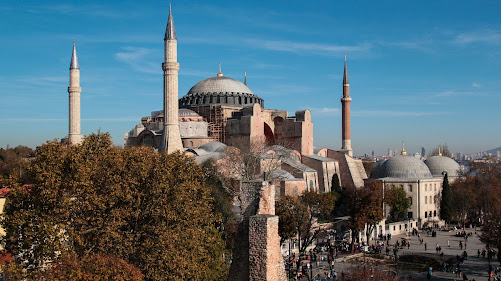
Architecture of Hagia Sophia

Hagia Sophia


For nearly 500 years Istanbul's main mosque, Hagia Sophia served as a model for many Ottoman mosques such as the Sultan Ahmed Mosque, the Sehzade Mosque, the Squeemaniye Mosque, and the Pasha Pasha Mosque.

Architecture :

Hagia Sophia is one of the heaviest examples of Byzantine architecture, both architectural and religious. Its broad nave is covered with a medium-sized upper bone made of pendentives. Pandentives form possible dome support on a square frame of equal arches that reside on large pillars. The arches at east and west are extended by great half domes, while the half domes, in turn, carried on smaller semi domed exedrae. 
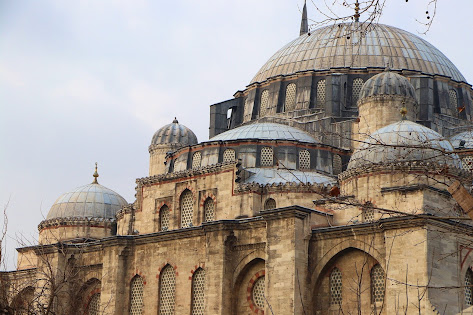
Architecture of Hagia Sophia

Architecture


At the east end of the temple house, there is a storehouse on the west and finally on the west a large narthex. Surrounding the nave to the north and south are sidewalks with porches above them. Their massive vaults, carried at both levels by columns of green and white marble.

Dome :

The vast nave is covered by a central dome which has a maximum diameter of 31.24 meters and a height from the floor level of 55.60 meters. The dome looks weightless with an endless arcade of 40 windows below it, helping to flood the colorful interior with light.
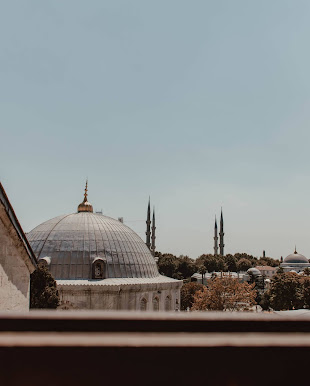
Architecture of Hagia Sophia

Dome


The dome is made of the pendant, the four triangular stone structures that solve the problem of laying a circular base of the dome on a rectangular base. In Hagia Sophia, the weight of the dome passes from the pendant to the four main poles in the corners. Among them, the dome appears to run over four huge arches.
All interiors surfaces are sheathed with polychrome marbles, green and white with purple and gold mosaics, covered on the brick. On the exterior, simple stucco walls reveal the clarity of massed vaults and domes.
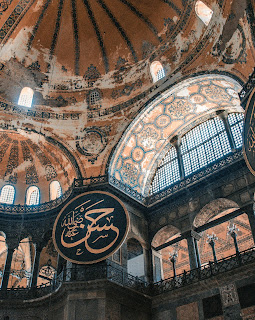
Architecture of Hagia Sophia

Interior of Dome


Minarets :

One of the Minarets was built from red brick while the other three were built from white limestone and sandstone.
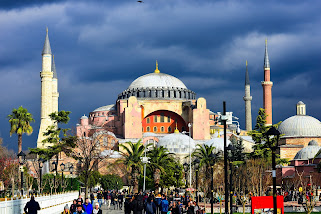
Architecture of Hagia Sophia

Minarets


Lustration Urns :

Two huge marble lustration urns were brought from Pergamon during the reign of Sultan Murad III. Stemming from the Hellenistic period, they are carved from single blocks of marble.

Narthex and Portals :

The Imperial Gate was the main entrance between the exo- and exonarthex. It was reserved only for the emperor. The Byzantine mosaic above the portal depicts Christ and an unnamed Emperor. A long ramp from the northern part of the outer narthex leads up to the upper gallery.

Upper Gallery :

The upper gallery is laid out in a horseshoe shape the encloses the nave until the apse. Several mosaics are preserved in the upper gallery, an area traditionally reserved for the empress and her court.

 Loge of the Empress :

The loge of the empress is located in the center of the upper enclosure, or gallery, of the Hagia Sophia. From there the empress and the court ladies would watch the proceedings down below. A round, green stone marks the spot where the throne of the empress stood.

Marble Door :

The marble door inside the Hagia Sophia is located in the southern upper enclosure or gallery. It was used by the participants in synods, they entered and left the meeting chamber through this door.

Decorations :

Originally the interior decoration consisted of abstract designs of the marble slab on the walls and mosaics on the curving vaults. There were already figurative decorations. The spandrels of the gallery are revetted in opus sectile. showing patterns and figures of flowers and birds in a cut piece of white marble, set again the background of black marble.

Mosaics:

Imperial gate mosaic located in the tympanum above the gate used only by the emperors when entering the church. It represented the emperor Leo VI bowing down before Christ Pantocrator, giving His blessing and holding in his left hand an open book. These mosaics express the timeless power bestowed by Christ on the Byzantine emperors.
Southwestern entrance mosaics, situated in the tympanum of the southwestern eastern, date from 944.
They were rediscovered during the restorations of 1849 by Fassati. The Virgin sits on a throne without a back, her feet resting on a base, embellished with precious stones. The child christ sits on her lap, giving His blessing and holding a scroll in His left hand.
Empress Zoe mosaics on the eastern wall of the southern gallery date from the 11th century. Following the building converted into a mosque in 1453, many of its mosaics were destroyed or covered with plaster, due to Islam's ban on representational imagery. This process was not completed at once, and reports exist from the 17th century.

Stay tuned for more informative blogs. Thank you.


Saturday, December 12, 2020

Topkapi Palace - Istanbul - Turkey

 Upon conquering Constantinople, Mehmed II ordered the building of a monastery on the site of the fourth-century theater of Emperor Theodosius I. With the completion of the palace at Beyazit, work began on a new palace in the seraglio area. The New Imperial Palace is known today as the Topkapi Palace. It is located at the top of a hill at the end of the historic peninsula where the waters of Marmara, Bosphorus, and the Golden Horn meet. The Topkapi Palace was restored in the 1950s by the management of the Topkapi Palace Museum and is open to visitors.

Topkapi Palace

Topkapi Palace

The Palace Structure :

The first court is entered through the Imperial Gate on the fortress, across from the Church of Hagia Sophia. The entrance of the 2nd court is through the middle gate, or the salutation or Bab-ul-salam that was built by Mehmed II. The gate was renovated by Murad II in the late 16th century and no longer has its original gilded doors or portico.
The third court houses the palace of school for pages, the sultan's headquarters, and his treasury. it is entered through the gate of Felicity.
Small passages between the Hall of Treasury and the Department of the Pantry lead into the Fourth court, a loose collection of Kiosks built on three levels. 

Architectural Characteristics :

1. Imperial Gate :

The massiveness of this stone gate emphasizes its defensive character. Its central arch leads to a high-doomed. Guilded Ottoman Calligraphy adorns the structure at the top, with verses from the Holy Quran and Tughras of the Sultans.

Topkapi palace


2.First Courtyard :

The exterior of glazed bricks shows a Central Asian influence, especially from the Bibi-Khanum Mosque in Samarkand. The square, the axial plan represents the four corners of the world and symbolizes, in architectural terms, the universal authority of the Sultan. As there is no Byzantine influence, the building is ascribed to an unknown Persian architect. The stone framed brick and the polygonal pillars of the facade are typical of Persia.

Topkapi palace


3.Gate of Salutation :

This gate has two large octagonal pointed towers. The date of construction of this gate is not clear, since the architecture of towers in Byzantine influence rather than Ottoman. The gate is richly decorated on both sides and in the upper part with religious and monograms of Sultans.

4.Second Courtyard :

Numerous artifacts from the Roman and Byzantine periods have been found on the palace site during recent excavations. These include sarcophagi, baptismal fonts, parapet slabs, and pillars and capitals.

5. Harem:

The harem wing was only added at the end of the 16th century. Many of the rooms and features in the Harem were designed by Sinan. The harem was decorated again under the sultans Mahmud I and Osman III in Italian inspired Ottoman Baroque style. These decorations contrast with those of the Ottoman classical age.

6. Imperial Hall  :

The imperial Hall is also known as the Imperial Sofa, Throne Room within or Hall of Diversions is a domed hall in the Harem, believed to have been built in the late 16th century , It has the largest coming in the palace. After the great Harem fire of 1666, the hall was renovated in the rococo style during the reign of Sultan Osman III.

Topkapi Palace


7. Fountains of Sultan Ahmed III :

The great square fountains are Rocco building in front of the palace gate that was built under Sultan Ahmed III in 1728. It was a social centre and gathering place. Each of the four facades contains a drinking fountain, flanked by niches and decorated in low relief with floral design.


Monday, December 7, 2020

Functions of Islamic Calligraphy Art in Islamic Culture

 There are many functions in Islamic calligraphy art in Islamic culture.

1. Quranic.

2. Poetry.

3. Architectural decoration.

4. Wall decoration

5. Numismatics.

6. Religious and administration documents.

7. Single decoration Album pages.

8. Tughra.

9. Ornamental inscriptions on small objects.

1. Quranic :

Probably the most important function for decorative writing in Islamic culture is that producing copies of the Holy Quran. Not only is the actual text executed in beautiful and legible writing, but many decorative additions are often combined with text.

Functions of Islamic Calligraphy Art in Islamic Culture

Quranic Calligraphy on Kaabah


(a) Rosettes, Medallions, and Roundels :

The earliest ornaments used were rosettes, medallions, and roundels. These occur as marginal decorations to mark the ends of ayahs and Surahs, or to indicate the ajza, the ashirahs, or sajdah.


Function of Islamic Calligraphy Art in Islamic culture

Roundels in the Quran 


(b) Ornamental Panels :

Another form of Quranic Ornamentations probably originated in the 9th century. This consists of decorative bands and panels. These appear at the opening of the surahs, or perhaps only to introduce specific surahs chosen for more elaborate decoration. The panels usually contain the title and number of the surah to follow, as well as the number of its verses.


Function Of Islamic Calligraphy Art in Islamic Culture

Ornamental Panels


(c) Single Decoration Pages :

In the Quran copies of the 10th century are found the earliest examples of full-page arabesque ate the beginnings and end of the books or chapters. These use a wide variety of motifs for additions, molding, and integration calligraphic designs. Such decorative pages were later to became an expected part of any finely produced manuscript. Beautiful examples of these are displayed in the calligraphy exhibit of the Topkapi Saray Museum in Istanbul.

Functions of Islamic Calligraphy  Art in Islamic Culture

Single decoration Page


2. Poetry 

Beautiful calligraphy is also found in copies of poetic works. These have not been given the consistent care or the elaborate exercise of writing talent the calligraphers have shown to the Holy Quran. Yet, some beautiful examples can be found, especially in the Iranian and Indian Islamic legacy.

Functions of Islamic Calligraphy Art in Islamic Culture


3. Architectural Decoration :

Calligraphy played an im[ratnt role in architectural decoration of every type, in all regions and periods. Passages from the Quran are the most frequent literary material used in these decorations. The designs of beautiful writing may be only pannels, borders, doors, or maybe on the structural elements. They are made up of a variety of materials, used singly or in combination. The most common of these media are bricks, ceramics, craved stucco, carved and painted wood, and stone.


4. Wall Decoration :

The production of calligraphy design for wall decoration has been an art practiced in all Muslim regions and times. In corporating short passages from the Quran, pious saying, the names of God or attributes of God as well as the name of Prophet Muhammad S.A.W.W and the early caliphs have been a favorite subject for such decoration. They are hung on the walls of both domestic and public buildings in the Muslim World. Pieced textiles, paint on paper, embroidery, bamboo, carved ivory, stucco, plaster, shaped metals, ceramics, and even plastics are the popular material for this decoration which are cherished by Muslims everywhere.

5. Numismatics :

Coins have provided instances of decorative calligraphy from the first century of Islam till today. Particularly beautiful examples can be viewed in the books of Miles and People. Some of the coins contain only the necessary information concerning the value and origin of the coin written in a beautiful script. Others include the calligraphic design with the word ''Allah'', a tughra of the ruler issuing the coin, or a pious saying in elaborate script.

6. Religions and Administrative documents:

Given the predilection for beautiful writing, it is not strange that religious and admins documents produced by the Muslims were also executed with great care and decorative skill. The Diwani script is the one most favored for such documents, but titles and headings in thuluth are also common.

7. Single decoration Album Pages :

Around 1500, a fashion the creation of albums containing miniature illustrations, arabesque designs, and calligraphic pages developed in Persia after its introduction from China. It was soon to move to India where the  Mughal emperors further developed this use of calligraphy. 

8. Tughra :

These are decorative signature seal designs created by calligraphers for wealthy patrons or political leaders. Each one of the carriers the name of its owner written in an elaborate combination of thuluth and Diwani script to form an attractive design. The tughra was used not only as a signature for messages and documents but also as emblems for heading imperial edicts. A typical example is shown in Illustration.

9. Ornamental Inscriptions on Small Art Objects:

No accouterment of a public building or individual residence is considered complete without a suitable calligraphic decoration. Whether for public and private use, ceramics bowls or plates, metal vessels, wooden furniture, glass bowls, or lamps, rugs, textile hangings, and garments.

Thank you. Stay Tuned for more informative blogs.


City of Al- Rafiqa , Syria - Islamic Arts And Architecture

Baghdad was not the only city founded by Caliph Al-Mansur. He also developed a site in northern Syria on the east bank of the Euphrates Rive...