Search This Blog

Showing posts with label Arts. Show all posts

Wednesday, February 10, 2021

Academic Achievements of Abassids


Abu Jafar Al-Mansur, the second Abbasid Caliph, was a very learned person of his time who showed great interest in the development of scientific learning. The famous scholar of his age was Imam Abu Hanifa, Ibn Ishaq, Imam Malik, Abu Amr Abd Al-Rehman Ibn Amr, And Sufyan Al-Thawri. The most popular scholar of his time was Abdullah Ibn Muqaffa.

Under the Abbasids, higher education in science was carried out on an individual basis rather than the establishment of institutions of higher learning. Afterward, they Sponsered observatories and hospitals in different parts of the caliphate. Most of the scholars were celebrated for their standing in different disciplines and their achievements in more than one science. Within a short time Muslim philosophers, mathematicians, physicians, geographers, alchemists, botanists had worked throughout the caliphate and achieved the amazing accomplishment of uncovering the vast intellectual heritage received from the earlier civilizations.

The 5th caliph of the Abbasid Dynasty, Harun al-Rashid is remembered as one of history's greatest patrons of the arts and sciences. Under his rule, Baghdad became the world's most important center of science, philosophy, medicine, and education. The massive size of the caliphate meant that it had contact and shared borders with many distant empires, so scholars at Baghdad could collect, translate and expand upon the knowledge of the other civilizations, such as the Egyptians, Persians, Indians, Chinese, Greeks, Romans, and Byzantines.

The successors of Harun al- Rashid, especially his son al- Ma'mun continued his policies of supporting artists, scientists, and scholars. Al- Mamun founded the Bayt al Hikma, the house of wisdom in Baghdad. At the house of wisdom, important ideas from around the world came together. The introduction of Indian numerals, which have become standard in Islamic and Western worlds, greatly aided in mathematics and scientific discovery.

Scholars such as Al- Kindi revolutionized mathematics and synthesized Greek philosophy with Islamic thought. Al- Biruni and Abu Nasar Mansur among many other scholars made important contributions to geometry and astronomy. Ibn Musa, expanding upon Greek mathematical concepts, developed Algebra which is derived from his landmark textbook Kitab al Jabar wal Muqabala. Ibn al- Haytham made important contributions to the fields of optics.

Medicine:

Medicine in medieval Islam was an area of science that advanced particularly during the Abbasids region. During the 9th century, Baghdad contained over 800 doctors, and great discoveries in the understanding of anatomy and disease were made. Famous Persian scientists produced thesis and worked that summarized the vast amount of knowledge that scientists had accumulated, and was very influential through their encyclopedias. 

Astronomy :

Astronomy was advanced by Al- Battani, who improved the precision of the measurement of precession of the earth axis. The astrolabe, though originally developed by greeks, was developed further by  Islamic astronomers and engineers, and subsequently brought to medieval  Europe.

Al Chemist :

Muslim alchemists influenced medieval European alchemists, particularly the writings attributed to Jabir Ibn Haiyan. A number of chemical processes were developed in the Muslim world and then spread to Europe.

Agriculture :

A number of very practical innovations took place, especially in the field of agriculture. Improved methods of irrigation allowed more land to be cultivated. Crops and farming techniques were adopted from neighboring cultures. Rice, cotton, and sugar were taken from India, citrus food from China, and sorghum from Africa. 

Literature :

The best-known fiction from the Islamic world was The Book of Thousand and One Nights. The original concept is derived from pre-Islamic Iranian with reliance on Indian elements. It also includes stories from the rest of the Middle-Eastern and North African nations. 

Arabic poetry reached its greatest highest in the Abbasid era. A famous example of Arabic poetry on romance was Layla and Majnu. which further developed mainly by Iranians. Azerbaijan and other poets in Persian, Turkish, and other Turk languages dating back to the Umayyad era in the 7th century.

Saturday, January 9, 2021

Art of ottoman Empire - Before & After 1600 BC


Before 1600 BC

At its inception in the early fourteenth century, the Osmanli or Ottoman Empire was one of many empires that emerged as a result of the dissolution of the Seljuq sultanate in Anatolia and subsequent instability caused by the Mongol empire. The dictatorial Ottoman Empire, bordering the Islamic world, gradually absorbed the Byzantine territories of Anatolia and the Balkans. In 1453, this expansion led to the Ottoman ban on Constantinople, the capital of Eastern Christendom. With the defeat of the Mamluk empire in 1517, the Ottomans ruled over the most powerful empire in the Islamic world. In the middle of the sixteenth century, the continued military success in the region from Central Europe to the Indian Ocean gave the Ottomans the status of world power.

In the arts, there is a shortage of material that existed from the earliest Ottoman period, but it is clear from the surviving buildings that Byzantine, Mamluk, and Persian cultures combined to form the vocabulary of Ottoman art. Significant changes have taken place with the establishment of new capital in the Byzantine region of Constantinople. After the victory, Hagia Sophia, a large Byzantine church, was converted to Islam and became a source of encouragement to Ottoman architects. Mehmet II ) regarded the city as the center of his growing empire and embarked on a grand reconstruction program. He sent two palaces (The Old and the New, later Topkapi, palaces) and a Muslim church (Mehmetiye, which later became the Fatih complex), which included religious, educational, social, and commercial activities. In his commissions, Mehmet drew Turkish, Persian, and Byzantine artistic expressions.  He was interested in development in western Europe. Ottoman, Iranian, and European artists and scholars flocked to Mehmet's courtroom, making him one of the greatest Renaissance emperors of his time.

Under Mehmet's successors, his eclectic style, reflecting a mixed Ottoman heritage, was gradually incorporated into Ottoman art vocabulary. Further expansion of the area brought some additions to this vocabulary. Most importantly, the defeat of the Safavids in the war in eastern Anatolia (1514) and the addition of the Mamluks in Syria, Egypt, and the Holy Cities of Islam (Mecca and Medina) in the Ottoman Empire under Selim I, led to an increase in the presence of Iranian and Arab artists and scholars in the Ottoman court.

Süleyman's reign often referred to as the "Golden Age," was characterized by expansion, trade, and economic growth, as well as a cultural and artistic activity. Süleyman's years saw the rise of Ottoman art and culture. Among the major achievements of this period were the temples and religious buildings built by Sinan, one of the most famous Muslim architects. Hundreds of public buildings were designed and built throughout the Ottoman Empire, contributing to the spread of Ottoman culture. In the period following Süleyman's death, construction and artwork resumed under the support of the royal family and the ruling class. Commissions continue outside the state capital, with many sacred foundations established throughout the state.

By the end of the fifteenth and sixteenth centuries, progress was being made in all fields of art, where architecture, calligraphy, hand painting, textiles, and pottery were of paramount importance. Apart from Istanbul, various cities in the provinces are also considered major centers of the arts and commerce: Znik was famous for its pottery, Bursa for silk and textiles, Cairo for carpet production, and Baghdad for its art. Ottoman observation has had a profound effect on the various regions under its control. Aside from local diversity, the legacy of 16th-century Ottoman art is still evident in monuments from the Balkans to the Caucasus, from Algeria to Baghdad, and the Crimea to Yemen, including signature objects such as celestial houses, small pencils - standing minarets, and standing courts with home arches.

After 1600 BC :

At the beginning of the seventeenth century, both the production of Ottoman literature and architecture remained traditional. The court scriptorium went on to publish its own series of used documents - biographies, travel accounts, genealogies, and geographical locations - many of which were displayed or illuminated. The Ahmet I Mosque in Istanbul (1609-16), also known as the "Blue Mosque" due to the internal system of tiles, continues in the vocabulary of Sinan's great artist (c. 1500-1588).

Later in the century, the weak Ottoman economy began to undermine the arts. The influx of gold and silver from the New World has caused inflation and the treasury to dwindle without a victory in the war and the spoils to fill the coffers. The Sultans were forced to reduce the number of artists hired in Nakkaşhane (royal scriptorium) to ten from over 120 during the reign of Süleyman the Magnificent (r. 1520-66), and for many years did not increase the prices they paid for pottery, paintings, and carpets. It has been more profitable for artists to produce open market items than to be tied to workshops in low-paying courts, and sultans had to pass orders forcing them to complete state commissions. One of the arts that maintained a high level of quality was calligraphy. Hafiz Osman was the ruler of this period, a teacher of Sultan Mustafa II  and his son, Sultan Ahmet III.

Under Ahmet III art has been revived. He built a new library at Topkapi Palace and authorized the Surname (Book of Festivals, ca. 1720, Topkapi A.3593), recording the circumcision of his four sons as recorded by the poet Vehbi. These paintings depict ceremonies and processions on the streets of Istanbul and were completed under the direction of the artist Levni (who died in 1732), whose work is known from a set of photographs collected in ‘vellum’ (Topkapi H.2164). While his style was traditional, other artists of his time were deeply influenced by European literature and recordings that began to spread throughout the Ottoman world.

Ahmet's reign is also known as the Tulip Age. The popularity of this flower is reflected in the new floral decoration that has changed the saz style of decorating with beaded leaves and cloud belts that have reflected Ottoman art for many years, and are found in fabrics, light, and decorative architecture. The construction of this period is shown in a large fountain built by Ahmet III outside the gate overlooking the Topkapi palace. Ambassadors sent to Paris and Vienna brought other changes in their interpretation of the Baroque buildings in Versailles and Fontainebleau, but many Baroque-inspired palaces built during Ahmet's reign were destroyed by a revolt that forced him to resign in 1730. The first building to survive was the Nuru Osmaniye Mosque (1748-55), which was started by Mahmud I and completed by Osman III. Its glorious decoration, beautiful composition, and carvings of vegetables are a hallmark of a style that dates back to the nineteenth century.

Stay connected for more Informative blogs. Thankyou!

Sunday, January 3, 2021

The Culture of Ottoman Empire

The culture of Ottoman Empire

Ottoman culture flourished for centuries as the Turks' rulers suckled, transformed, and transformed the various indigenous cultures of the conquered lands and their peoples. There was a strong influence on the customs and languages ​​of Muslim communities, especially the Arabs, while Persian culture had a profound effect on the Persians of the Seljuq Turks, who were pre-Ottoman. Without further ado, the Ottoman Empire, like its predecessors in the Sultanate of Rum and the Seljuk Empire, was thoroughly investigated by their culture, language, customs, and traditions, and therefore, the empire was described as a Persian empire. Throughout its history, the Turkish Empire had a large population of Orthodox, Armenian, Jewish, and Assyrian subjects, who were allowed to govern themselves under a united government. The Ottomans and their distinct cultures enrich those of the Ottoman Empire.

Literature:

Poetry :

Like all other forms of Turkish art, poetry produced by the Ottoman court circle has had a powerful influence from ancient Persian cultures; Ghazal) was used.

In the 19th century and during the conversion of the Tanzimat, the influence of Turkish folklore, up to that point, in particular, began to emerge in Turkish poetry, and there was a growing influence on European literature; there has been a corresponding decline in ancient court poems. Tevfik Fikret, born in 1867, is often regarded as the inventor of modern Turkish poetry.

Prose:

Prior to the 19th century, Ottoman prose was not only true but much more advanced than Ottoman poetry, in part because most of it followed the original rules of the Arab rhymed prose (Saj '). However, many genres - travelogue, political literature, and biography - were now available.

From the 19th century onward, the growing influence of European novels, especially those of the French novel, began to be felt. Şemsettin Sami's book Taaşuk-u Tal'at ve Fitnat, widely regarded as Turkey's first novel, was published in 1872; other Ottoman prose writers were Ahmet Mithat and Halit Ziya Uşaklıgil.

Architecture :

The Ottoman architecture was an integral part of the Iranian-influenced Seljuk architecture, as reflected in the Konya architecture, the Mamluk architecture, and the Byzantine architecture; reached its greatest development in major public buildings, such as mosques and caravans, in the 16th century.

A prominent figure in this field, the 16th-century designer and engineer Marimar Sinan, was a Muslim convert from Armenia who had knowledge of the Janissaries. One of his students, Sedefkar Mehmed Agha, designed the 17th-century Blue Mosque, which is considered to be the last major construction of ancient Ottoman architecture.

Decorative Arts :

Calligraphy :

Calligraphy had a respectable culture in the Ottomans, whose traditions were shaped by the work of the Abbasid calligrapher Yaqut al-Musta'simi of Baghdad, whose influence spread throughout the Muslim world, al-Musta'simi himself who was of Anatolian descent.
Diwani's script is a distinctive and vivid Ottoman style of Arabic calligraphy dating back to the 16th and early 17th centuries. Founded by Husam Roumi, it culminated in a major development under Süleyman I the Magnificent (1520-66). The most decorative script is divided by the complexity of the line and the clear definition of the letters in the words. Other forms include the flowing, circular Nashki text, founded by the 10th Abbasid calligrapher Ali Muhammad ibn Muqlah, and Ta'liq, based on the Persian Nastalīq style.
Well-known Ottoman calligraphers include Seyid Kasim Gubari, Şeyh Hamdullah, Ahmed Karahisari, and Hâfiz Osma.

Miniatures :

The Ottoman culture of miniature painting, handwriting, or use of dedicated albums was largely influenced by Persian art form, although it also incorporated elements of Byzantine culture into lighting and painting.

Carpet-weaving and textile arts :

The art of weaving carpets was very important in the Ottoman Empire, carpets were very important as decorative items, rich in religious symbols, and so on, and as a practical consideration, as was the custom to remove shoes from the living space.  The weaving of such carpets originated in the nomadic traditions of central Asia and eventually spread to communities living in Anatolia. The Turks use patterned carpets, magazines, and creams not only on the floor of the room but also as hanging on walls and doors, where they provide additional installation. And they were often donated to the churches of the temples, where they usually collected their large collections

Jewelry :

The Ottoman Empire was known for the quality of its gold and silver carpenters, and especially for the jewelry, they produced. Jewelry was especially important when it came to weddings, such as wedding invitations. Silver was the standard used, and gold was reserved for high-quality pieces; designs often depicted complex work and included Persian and Byzantine paintings. Progress in construction reflected the Ottoman court's interest in the Persian Safavid art, which, for example, became influential after the defeat of Ottoman Ismail I after the Chaldiran war in 1514.  In the rural areas of the Empire, jewelry was simple and often included gold coins, but the formation of Constantinople spread throughout the Ottoman Empire and was reflected in the Egyptian and North African metals.

Monday, December 7, 2020

Functions of Islamic Calligraphy Art in Islamic Culture

 There are many functions in Islamic calligraphy art in Islamic culture.

1. Quranic.

2. Poetry.

3. Architectural decoration.

4. Wall decoration

5. Numismatics.

6. Religious and administration documents.

7. Single decoration Album pages.

8. Tughra.

9. Ornamental inscriptions on small objects.

1. Quranic :

Probably the most important function for decorative writing in Islamic culture is that producing copies of the Holy Quran. Not only is the actual text executed in beautiful and legible writing, but many decorative additions are often combined with text.
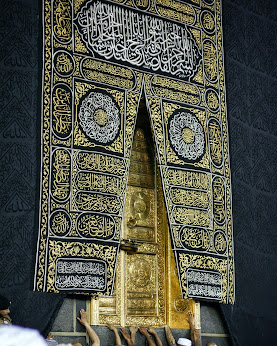
Functions of Islamic Calligraphy Art in Islamic Culture

Quranic Calligraphy on Kaabah


(a) Rosettes, Medallions, and Roundels :

The earliest ornaments used were rosettes, medallions, and roundels. These occur as marginal decorations to mark the ends of ayahs and Surahs, or to indicate the ajza, the ashirahs, or sajdah.
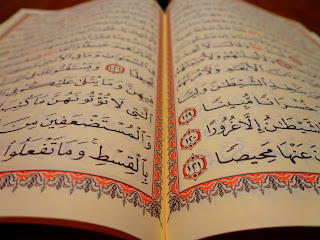


Function of Islamic Calligraphy Art in Islamic culture

Roundels in the Quran 


(b) Ornamental Panels :

Another form of Quranic Ornamentations probably originated in the 9th century. This consists of decorative bands and panels. These appear at the opening of the surahs, or perhaps only to introduce specific surahs chosen for more elaborate decoration. The panels usually contain the title and number of the surah to follow, as well as the number of its verses.
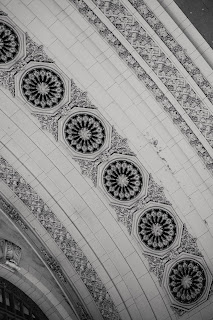

Function Of Islamic Calligraphy Art in Islamic Culture

Ornamental Panels


(c) Single Decoration Pages :

In the Quran copies of the 10th century are found the earliest examples of full-page arabesque ate the beginnings and end of the books or chapters. These use a wide variety of motifs for additions, molding, and integration calligraphic designs. Such decorative pages were later to became an expected part of any finely produced manuscript. Beautiful examples of these are displayed in the calligraphy exhibit of the Topkapi Saray Museum in Istanbul.
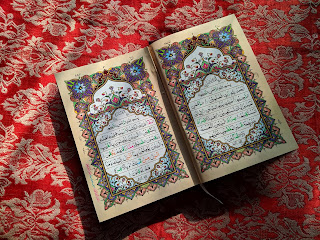
Functions of Islamic Calligraphy  Art in Islamic Culture

Single decoration Page


2. Poetry 

Beautiful calligraphy is also found in copies of poetic works. These have not been given the consistent care or the elaborate exercise of writing talent the calligraphers have shown to the Holy Quran. Yet, some beautiful examples can be found, especially in the Iranian and Indian Islamic legacy.

Functions of Islamic Calligraphy Art in Islamic Culture


3. Architectural Decoration :

Calligraphy played an im[ratnt role in architectural decoration of every type, in all regions and periods. Passages from the Quran are the most frequent literary material used in these decorations. The designs of beautiful writing may be only pannels, borders, doors, or maybe on the structural elements. They are made up of a variety of materials, used singly or in combination. The most common of these media are bricks, ceramics, craved stucco, carved and painted wood, and stone.


4. Wall Decoration :

The production of calligraphy design for wall decoration has been an art practiced in all Muslim regions and times. In corporating short passages from the Quran, pious saying, the names of God or attributes of God as well as the name of Prophet Muhammad S.A.W.W and the early caliphs have been a favorite subject for such decoration. They are hung on the walls of both domestic and public buildings in the Muslim World. Pieced textiles, paint on paper, embroidery, bamboo, carved ivory, stucco, plaster, shaped metals, ceramics, and even plastics are the popular material for this decoration which are cherished by Muslims everywhere.

5. Numismatics :

Coins have provided instances of decorative calligraphy from the first century of Islam till today. Particularly beautiful examples can be viewed in the books of Miles and People. Some of the coins contain only the necessary information concerning the value and origin of the coin written in a beautiful script. Others include the calligraphic design with the word ''Allah'', a tughra of the ruler issuing the coin, or a pious saying in elaborate script.

6. Religions and Administrative documents:

Given the predilection for beautiful writing, it is not strange that religious and admins documents produced by the Muslims were also executed with great care and decorative skill. The Diwani script is the one most favored for such documents, but titles and headings in thuluth are also common.

7. Single decoration Album Pages :

Around 1500, a fashion the creation of albums containing miniature illustrations, arabesque designs, and calligraphic pages developed in Persia after its introduction from China. It was soon to move to India where the  Mughal emperors further developed this use of calligraphy. 

8. Tughra :

These are decorative signature seal designs created by calligraphers for wealthy patrons or political leaders. Each one of the carriers the name of its owner written in an elaborate combination of thuluth and Diwani script to form an attractive design. The tughra was used not only as a signature for messages and documents but also as emblems for heading imperial edicts. A typical example is shown in Illustration.

9. Ornamental Inscriptions on Small Art Objects:

No accouterment of a public building or individual residence is considered complete without a suitable calligraphic decoration. Whether for public and private use, ceramics bowls or plates, metal vessels, wooden furniture, glass bowls, or lamps, rugs, textile hangings, and garments.

Thank you. Stay Tuned for more informative blogs.


Wednesday, November 25, 2020

Glass Making - Enameled And Gilded Glass

 At the same time of the Arab conquest in the 7th century A.D., glass making had flourished in Egypt and western Asia. For more than two thousand years and glassmakers in those regions have been doing business in spite of the dramatic political, social, and religious changes taking place around them. The glassmakers inherited many of their ancestral techniques in the Byzantine and Sasanian empires, including the piercing of glass, the use of the mold, the use of molten glass with tools, and the decoration of molten glass. The manufacture of Islamic glass from the 7th to the 14th century also invented new inventions and was witnessed by the glorious stages, which established its magnitude in producing glass around the world.

While many of the objects may not have been made under a ruler's patronage, they certainly are ''fit for a sultan''.Islamic glass can be better studied according to its handling techniques from unadorned decorative vessels to Moses' glass in pottery, hot, cut, and carved, although ships were manufactured after the 17th century and heavily influenced by Europe.

In the field of Islamic art, glass is a work of art that often rises but is often overlooked by art historians. The 1,000 unknown glassmakers, who travel from Cairo to Delhi, proudly pass on their knowledge from one generation to the next, experimenting with the colors, shapes, techniques, and embellishments of this vast variety. Their outstanding results, from the public to private collections around the world, promote a wide range of knowledge of the art forms of Islamic glass, a worthy legacy to this ancient artwork.

Enameled And Gilded Glass:

The enameled and horizontal glass is the most famous and historically Islamic glass of history. The production of such glass was the specialty of regions controlled by the Ayyubids and the Mamluks in the 13th and 14th centuries. For this decoration, gold and enamels were applied to the glass surface using oil and a brush or reed pen. Because the gilt colors and individual coatings have different chemical properties, different temperatures are required to permanently fix them to the glass. Simultaneous coloring and remodeling can put the ship in regeneration several times and endanger the deformity of its structure, so it is possible that Mamluk glassmakers learn the product when they apply all the colors at once and fix it during a single shot in Kiln without merging.

Glass Making - Enameled And Gilded Glass

Gilded Glass


The vast amount of fossil record indicates that such vessels were highly prized and were probably used for special occasions. The sheer number of pieces available, however, suggests that the product was not only court-sponsored but also for commercial purposes. These unpainted areas of these objects and the favors of Mamluk painters and literary enthusiasts make this type of Islamic glass very instructive, helping scholars to establish chronology and delivery.
Enameled and gilded glass developed in the 12th century in the Syrian area and flourished during the final decades of Ayyubids power and the first of Maluk domination in the 13th century. When Cairo became the capital of the empire in the 14th century, stained-glass and stained glass from that time were probably made in Egyptian workshops, rather than in Syria. The late 14th century saw a decline in production, by the early 15th century, decreasing support eventually caused workshops to close. By the end of the 15th century, large-scale glass production had shifted from Europe to Venice, in particular. The combination of economic, political, and artistic elements may have caused the disappearance of stained glass from the Islamic world.


Saturday, November 21, 2020

Objects In Islamic Art - Techniques of Early Islamic Art

 Followings are the objects of early Islamic Art.

  • Rock-cut crystals.
  • Cut and engraved Glass.
  • Millefiori
  • Stained Glass.
  • Etched Glass.
  • Cast Glass.
  • Tools of Glassmaking.
  • The Blowpipe.

Rock-cut Crystals :

Rock crystals ewers are pitchers craved from a single block of rock crystal. They were made by Islamic Fatimid artisans and are considered to be amongst the rarest object in Islamic art. Great skill was required to hollow out the raw rock crystal without breaking it and to carve the delicate, often very shallow, decoration.

Techniques of Early Islamic Art

Rock cut crystals


Cut and Engraved Glass :

Cold-cut glass became the most prominent art form of decoration in the early Islamic period, especially in the 9th and 10th  centuries. While this lapidary technique is as old as glass making itself, dating well before glassblowing was invented; Roman and Sasanian cut glass provided immediate models. From Egypt to Iran, Islamic cut and engraved decoration took various forms. ranging from complex relief patterns created using mechanically operated wheels and drills to hair width incisions made with a pointed tool.

Techniques of Early Islamic Art

Cut and Engraved glass


Millefiori :

Taken from the Italian words ''mille'' and ''fiori'' beads using this ancient Venetian technique are aptly named ''a thousand flowers ''. Prior to the term millefiori being used to describe it. This glasswork technique was simply called mosaic. The ancient Romans, Phoenicians, and Alexandrians are thought to have been the originators of this art-form making Itlay the premier glass working center of the world. In the late 13th century Venetian glassmakers were ordered by the Venetian republic to move their foundries to the island of Murano.

Objects in Islamic Art
                                       
                                        Millefiori 


The millefiori technique was rediscovered in the 8th or 9th century in Mesopotamia and was probably used in the production of objects for the ' Abbasid caliphs in Baghdad or Samarra. A number of surviving bowls and tiles suggest that it was used both for domestic furnishings and interior decoration. Examples such as these show the sophistication and range of Abbasid glassmakers.

Stained Glass :

The glass that has been colored, enameled, painted, or stained, especially by having pigments baked onto its surface or by having various metallic oxides fused into it a used in church windows, decorative lampshades. Stained glass is an art form in which colored glass is cut into shapes and placed into mosaics to form a picture. The glass is held in place by metal strips soldered together to give the stained glass strength and stability. Often, fine details of the scene are painted on the colored glass, which is then heated to bond the paint to the glass, and thereby 'stained'.

Objects in Islamic Art

Stained Glass


Etched Glass :

It is the result of international and often artistic carrying of the surface of the glass to leave a white, frosted finish. This technique is used to create designs on the glass. Etched glass can be found in a wide variety of decorative contexts, including glass doors and windows, furniture, wine bottles, and serving dishes such as glass platters. There are three ways to create a piece of etched glass: sandblasting, chemical etching, and acid etching.

Cast Glass:

Glass casting is the process in which glass objects are cast by directing molten glass into a mold where it solidifies.
The process of casting glass in molds was invented in the mid 2nd millennium BC. Although the core-formed method predominated in glass manufacture in the Greek world, casting techniques also played an important role in the development of glass in the 9th to 4th centuries B.C. Cast glass was produced in two basic ways, through the lost-wax method, and with various open molds.

Tools of Glass Makers :

Since the invention of glassblowing in the 1st century B.C., glassmakers have been using the same tools to model, manipulate, and decorate the molten glass. Two mold forms from the medieval Islamic world are the only ones to survive, but the basic technology of nonindustrial glassmaking and the tools employed have not changed.

The blowpipe :

It is an iron or steel tube, usually about five feet long, for blowing the molten glass. Molds are used to impress decorative patterns on the molten glass. Dip molds have the typical form of the conical beaker, but two or three-part hinged molds were also used in the Islamic world.

Stay tuned. Thank you


Thursday, November 19, 2020

Seljuk Architecture - Arts and Architecture


Arts and Architecture


 Seljuk Arts and Architecture in Persia, scarcely recognized as a distinct style before 1930, now comprises a repertoire of about fifty monuments and is increasingly regarded as one of the world's great architectural styles. A number of important monuments have been recorded within the last decade, still, many more come to light, Each discovery reveals new merits in structural inventiveness; double domes, ribs wider, vaults, taller minarets, and in decoration: stucco mihrabs, opulent and expressive overall arabesque networks, and in brick ornamentation patterns and bondings of infinite variety, vigor, and originality.

The power and nobility of Seljuk Arts and Architecture are doubtless best exemplified by the Masjid - i- Jami of Isfahan, one of the greatest buildings in the world. As a magnificent structure in a city chosen to be Persia's capital during widely separated epochs and under a variety of rulers, the Isfahan Jami is not purely Seljuk, but those portions which date from Seljuk times are yet is chief glories.

More than 900 years of Persian architecture revealed in this great mosque 20 distinct structures, varying in date from the 11th century. During its long history, it has been much fought over, repeatedly damaged, reconstructed, and all but ruined.

A four-iwan court is enclosed by arcades and two-story open galleries faced with mosaic faience on buff brick.  A deep iwan, embellished with especially strong faience revetments opens into a spacious domed sanctuary built, as the inscription state, by order of Nizam al Mulk at the beginning of MAli Shah's reign. Some of the earlier buildings are still visible, however, and it's probable that the lower section of this sanctuary itself dates from the late 10h century. The chamber supports a huge dome. The squinches are supported by huge cylindrical piers. The sanctuary is surrounded by arcades and corridors covered by an amazing variety of domical brick vaults. Frequently these vaults ret on columns that vary in date from pre-Seljuk to Safavid period. All of the iwans were rebuilt or redecorated on a Seljuk base, showing that the basic plan of the Jami existed during the Seljuk period.

Aesthetically, the most important unit in the Jami is the small but superlative north dome known as the Gunmbad - i - Kharka, dated 1088 and located at the opposite end of the central axis from the sanctuary. This is perhaps the most perfect dome known. In each corner, four small arched breaks form frames of Slender angle colonettes from the lower squinch extension. From Floor level, these colonettes lead the ee swiftly u to the typical tri-lobed squinch. The squinch itself is enclosed by a larger arch that, together with identical arches along the sidewalls, supports an octagonal ring of 16 shallow panels merged with the base of the dome.

All arch forms, including the dome, are of the same contour and constitute the key element of motif that, beginning in the corners, with successive comprehensive enclose one element within other until their multiplicity is resolved and merged in the dome. The dome is thus a culminating point in a vertically rising stream of force. 

There are some significant features of the building which are easily overlooked. The ceiling of the dome is ornamented by a huge cinquefoil in low relief which is assimilated to a five-pointed star. A section of these motifs penetrates at five spaced intervals from the periphery.

A beautiful little madrassa, the Hedariya is also in Qazvin, today incorporated into a large 19th-century mosque. Perhaps the finest Kufic inscription in relief in all Persia is in its stucco frieze. Its carved stucco mihrab is massively rich. The large Masjid I Jami at Qazvin is impressive by virtue of its serene sanctuary space, capped by a large dome. 

Several important Seljuk mosques, in the style of the Isfahan Jami, survive in relatively good condition: the Friday Mosques at Artisan, Zaware, and Gulpayagan and the shrine of Bayazid at Bistam, a brick minaret. The great Seljuk monuments of central Persia were rivaled by several structures built to the northeast, in Khurasan and the region of the Oxus. Of these, the gigantic RAbat-i-Malek Built before 1078  between Bukhara and Samarkand, is one of the most imposing ruins of the Islamic period. Only part of one wall of the Caravanserai remains. 

Sultan Sanger was buried at Merv mausoleum worthy of a noble and tragic figure. Constructed after his death in 1157 by devoted followers, this tomb is a solemn cubical chamber, about 90 feet high. The interlocking framework of the ribs seen on the interior seems to carry the weight of the dome but, in reality, it may be more decorative than structural. Brick latticework at the corners admitted light to the corridor around the base of the dome, further developing the tomb of Ismail Samanid. This mausoleum is the last, and one of the finest, examples of Seljuk Arts and Architecture.


Sunday, November 15, 2020

The Seljuks - Arts And Architecture


The Seljuks - Arts and Architecture

Seljuk architecture, Nobel and powerful, structurally invented and sophisticated, was neither sudden nor accidental. Rather it was the culminating expressions of a Persian renaissance that had begun in the early tenth century with the Samanids. this renaissance reached its apex under the Seljuks.

Cultural Background :

''Seek ye Knowledge even unto china''  commanded the Prophet Muhammad S.A.W.W and next to prayer, learning was regarded as the most sacred, preferable even to unreasoned piety. The productive stimulation of different, snd often competing, society was steadily enlarging and energizing Islamic culture life and thought. Most significant was the appropriation and preservation of classical Greek culture. Through well-organized translations financed by Caliph Mamun, Greek Philosophy and science Became known in Persia. Galen, Plato, and Aristotle were assiduously studied in all leaders of Persian thoughts.

During the 10th century, however, Persia again produced its own constellation of poets, Philosophers, mathematicians, astronomers, physical scientists, historians, and geographers most of them are brilliant, many of unequaled eminence, all with a high degree of originally, boldness, and cultural breadth. In comparison, the same years in Europe were dark indeed.

By far the most important element in the initiation of the native Persian revival was Firdawsi's poem Saha Nama, completed in 1010. One of the epics, it's entered immediately and permanently into the heart of the nation. In all of his 60,000 couplets he used no more than 984 Arabic expressions, the rest were purely Persian. He restored to the Persians the use of renovated magnificent language, created new confidence and patriotism.

The rulers, a number of the true scholars and even poets, rivaled each other in a patronizing poet, artists, and scholars. The honor of being a patron was regarded as the obligation of royalty and a valid claim to status and public esteem. The libraries of time tell the story of a widely shared culture, in which learning was revered. Sahib ibn Abba, vizir of the Buyids and successful ruler of most Persia before his death in 996, had a vast library of certainly more than 2000 volumes. Each mosque had a collection of books. The cadi of Nishapur designated a house with a library especially for the use of visiting scholars and even supplied them with living expenses. One famous library was complied by Abdul-ad dawla installed in a special building in Shiraz.

Both Buyid and Seljuk periods produced some of the most remarkable textiles ever achieved and the pottery, mostly from Nishapur and Samarkand, is among the finest ever made.

The second half of the 9th century saw the appearance of a number of encyclopedias and histories. The learned profession produced a number of great thinkers, components in many areas: Al Razi, physician, chemist, and physicist whose influence spread to make contained much valuable historical and even archeological material. He created a systematic star catalog, tables, and instruments. mathematics and astronomy were vigorously summarized in a Persian encyclopedia of 976, The key of the sciences, A group called the '' Brethren of sincerity'', published valuable commentaries.

Ibn Sina was a born mathematician, poet, and astronomers who made important contributions to physics and was one of the world's first great figures in medicine and his medical treatise were basic texts at Oxford as late as the 17th century.

Omar Khayyam was also an original philosopher and a great mathematician. He recognized 13 different forms of cubic equation in 1074. Al-Ghazali, a man of intellectual power, deep feeling, and utter dedications, was an outstanding poet and philosopher.

Into highly developed civilizations came the conquering Seljuks, an Iran- Turkish stock, Their leaders already familiar with the Persian culture established in Central Asia.


Stay Connected for more.


Thursday, November 12, 2020

Taj Mahal - Architecture In India

 Historical Background :

  • Taj Mahal is a mausoleum complex built by Shah Jahan (1632-1643) in memory of his favorite wife, Arjumand Banu Begum better known by her title ''Mumtaz Mahal''.
  • Construction of the building began shortly after Mumtaz's death.
  • Today Taj Mahal is recognized as the most perfect building in the world.
Taj Mahal - Architecture In India

Taj Mahal


Background :

  • According to Islamic traditions, a woman that dies during children's birth gains the status of martyr.
  • In 1631 Mumtaz passed away during the birth of her 14th child.
  • According to legend, with her dying breath, she secures a promise from her husband to built for her, a mausoleum more beautiful than any the world had ever seen.
  • 6 months after the death of his wife, Shah Jahan lays the foundation for a memorial near the river Jamna near his Palace in Agra.
  • To satisfy his Artistic obsessions, vast quantities of white marble are mined from Rajhastahn and are carried 250 miles to the site of the Taj Mahal.
  • The emperor reserves white marble for imperial building only.
  • Red stone carted from Dehli.
  • 20,000worker who labored over 20 years to build the monument.

Architectural Breakthrough :

  • In Indian architecture, the trabeation system was widely used for the construction of temples.
  • The Mughal introduce the concept of the arch to India and create very wide interior spaces.
  • Although the essential style was Islamic, any of the details are Hindu/Indian.
  • The Mughal introduced the use of ceramic tiles and precious stones for inlay work.

Engineering Breakthrough :

  • The Taj Mahal was built next to the river Jumna.
  • The Mughal Enginner's dug deep wells to below the water surface.
  • These wells were filled up with vocals and mortar.
  • On top of Well bases, the master builders erected stone columns, linked together by massive arches.
  • This engineering innovation has been protecting the Taj Mahal from the currents of the Jumna river to date.

Minarets Optical illusion :

  • The minarets of the Taj Mahal built to lean slightly outwards.
  • Depending on each other, they look perfectly straight.
  • This brings a massive advantage.

Taj Mahal - Architecture In India


Dome :

  • Today we can build a dome-like Taj Mahal using steel frames and other materials.
  • The master builders of the Taj Mahal had to solve this problem in stone.
  • They Laid stone on stone and built up the stone in rings.
  • The dome rises layer by layer.
  • The mortar between the stones gives its stability.

Design Components :

Minarets :

The tomb of Shah Jaha's own father provides the model for minarets.

Taj Mahal - Architecture In India

Minarets


Corner Turrets:

Shah Jahan great grandfather. Akbar tomb had four corner turrets surrounding the central core.

Taj Mahal - Architecture In India


Pishtaq :

The four Pishtaq is inspired by his grandfather Tomb.

Taj Mahal - Architecture In India


Dome :

The dome is inspired by Ulugh Beg Madrasa in Samarkand.

Taj Mahal - Architecture In India

Inside Dome


Religious Symbolism :

Taj Mahal is the architectural embodiment of this life and the next according to Islamic belief.
The ground plan represents this duality of life and the afterlife.
The complex is split between its tomb garden and mausoleum.

Taj Mahal - ArcIhtecture In India


Colour Scheme :

The color scheme of the Taj Mahal is deeply symbolic.
The worldly elements and other buildings are all clad in red stone.
The pure white stands for the Spiritually and faith of the person buried here.

Taj Mahal - Architecture In India


The Garden :

The Garden is the heart of the Taj Mahal.
It is an earthly representation of paradise described in the Quran.
The garden is divided into four squares.

Taj Mahal - Architecture In India

Chahar Bagh


The channels along the paths represent the river of paradise milk, honey, wine, and water mentioned in the Quran.
Where the channels meet, there is a pool.

European Influence:

The Taj Mahal itself demonstrates the link between India and Europe.
Technique and Motifs traveled from Europe to adorn the entire interior of the Taj Mahal.
These mosaics of semi-precious stones are called Pietra dura.

Taj Mahal - Architecture In India

Pietra Dura


This craft was used to decorate precious places during the renaissance.
This technique directly or indirectly traveled from Italy to India.
Unfortunately, no chronicles record the name of the artist who decorated the Taj Mahal.

Burial Chamber :

The coffin seen in the Mausoleum is only a cenotaph an empty monument.
Mumtaz Mahal lies in a secret marble chamber below the Taj Mahal, where she rests undistributed.

Here is the view of the Taj Mahal :


Wednesday, November 4, 2020

Fatehpur Sikri - Agra - Architecture In India

  • Fathepur Sikri is a Palace complex, built by the Mughal Emperor Abar in 1571- 1585 A.D.
  • One of the well-known Architecture in India.
  • The palace building is located on a hillside about 100 feet [40 m] above the artificial lake.
  • Akbar is responsible for the use of residence veneer, which gives the complex its characteristics hue.
  • There were two main stages in the construction of this building.
  • 1572 to 15757 A.D., when the main building was raised and finished.
  • 15757 to 1585, when passage and corridor added to building according to the need of the emperor and his family.
  • The complex served as the residence of the emperor for 14 years. in 1585 A.D. following a political and geographical shift of the empire, Akbar and his court satisfied transferred their residence to Lahore.


Architectural Features :

The following are the Architectural features of Fatehpur Sikri, Architecture in India.
  1. Market.
  2. Shop lined road.
  3. Karkhana or workshop.
  4. Octagonal Baoli.
  5. Hiran Minar.
  6. Hathipul or Elephant gate.
  7. Daulat kahana (aam o Khas) or Diwan e Khas.
  8. Kawabghah.
  9. Daftar Khana.
  10. Hammam.
  11. Courtyard of panch MAhal.
  12. Jadh Bai Palace.
  13. Raja Birbal house.
  14. Serai.
  15. Courtyard of Jami mosque.
  16. Jami mosque.
  17. Tomb of Saikh salim chishti.
  18. Tomb of Isa khan.
  19. Buland Darwaza.

  • It is situated on a long narrow ridge of Redstone that runs southwest to northeast.
  • The building inside the complex is rotated 45 degrees.
  • It is surrounded by enclosed walls that enclose the irregular place by about 2 miles and 1 mile long.
  • The whole complex is spread in the three Plates.
  • The mosque complex is located on the uppermost level of the ride and consists of a great mosque. The palace complex is laid out on the two lower platforms, covering 250 m sq.
  • The building of the complex can be grouped into two main zones.
  • The middle plateau is most private, housing the residential buildings, Birbal palace, Jodh Bai palace, Shahi Bazar, and Mina Bazar.Other buildings such as caravanserai, the Hiran Minar tower, hammam.
  • The dominant material used is red stone.
  • The building can be divided into two classes, the Religious and the secular.


Jami Mosque :


  • The Jami Mosque at Fatehpur Sikri, Architecture in India, was built by Akbar in 1571.
  • It covers a rectangular area measuring 542 X 438 and a large yard.
  • The mosque follows the standard plan form with the central courtyard.
  • The sanctuary facade consists of a large rectangular Pishtaq in the center.
  • Above and behind these central features rises a large dome over the central nave.
  • Arrange pillared kiosks all along the entire parapet.
  • The nave is a square hall entered through three doorway.
  • The aisles are accessible by highways from the nave. In the center of each hallway is a small church building, covered with one of the two smaller domes.

Buland Darwaza :

  • Buland Darwaza is a gateway built by Akbar about 25 years after the Jami Mosque.
  • The gateway is 134' high and 42 steps.
  • The structure is 130' wide and 123' deep.
  • The facade is embowed by the means of 3 planes comprising a large central face and a lesser one on each side.

Ftaehpur Sikri - Agra - Architecture In India


Buland Darwaza from Inside


  • The central plane is 86' wide and rectangular in shape.
  • The smaller planes are in three kevels varied opening at each stage. The main feature of the decorative treatment of the exterior facade is the wide border of the gate.

Tomb of  Salim Chishti :

  • It is located in the courtyard of the Jami Masjid at Fatehpur Sikri.
  • Originally a sandstone structure, it was transformed into an expensive marble structure.
  • The tomb consists of a 24-sided square exterior of the '16-sided chamber', all covered by a lower dome.
  • A wide verandah is carried out the outside.
  • There are carved brackets all around to support the extremely wides eaves.
  • The pillars that make up the porch with their honeycomb capitals.

Jodh Bai Palace :

  • Jodh Bai palace is a structure built as the house of the principle, Queen.
  • Mariam was a Hindu, and the palace in all its construction and all its ornamentations belongs to the Hindu and Jamia style of Mariam's native country, Rajputra, It even contains a Hindu temple.
  • The palace in plan measure 215' X 320', consisting of a large central courtyard.
  • To the left of the door is a small guardhouse.
  • The external hall is 32' high plan.
  • The outer part of the wall is disturbed only three times, once by the east gatehouse, the Pavillion hanging from the Hawa Mahal.
  • One of the most interesting features is the Hawa Mahal, Here the ladies enjoy the cool breeze and the view of the lake.

Birbal's House :

  • Raja Birbal was a Barhaman, who came to Akbar's court at the beginning of his reign.
  • From the construction, it would appear that h the Hindu were the architects.
  • Birbal's house s a two-story structure.
  • The ground story is made up of two rooms and an open terrace.
  • The upper rooms are covered with cupolas while the galleries have a pyramidal roof.

Diwan-i- Khas :

  • The Diwan-i-Khas or a hall of a private audience is the most distinctive of the administration building at the Fatehpur, Architecture In India.
  • It is not a large structure, Externally, the structure is rectangular in plan with two-story.
  • The interior arrangement is quite unique.
  • From the platform, a stone bridge radiates along each diagonal of the hall to connect with hanging galleries that surrounded its upper portion.
  • The idea behind the arrangement is that the emperor would occupy the central position.

Thankyou stay tuned for more.


Tuesday, September 22, 2020

Qantaret Harba Bridge - Samarra - Iraq

Qantaret Harba Bridge


Qantaret Harba Bridge - samarra - iraq


  • Qantaret Harba is a bridge located in the vicinity of Balad's rail station, a city ninety kilometers north to Baghdad.

  • It lies on the main road connecting Baghdad to Samarra and Tikrit.

  • The bridge was named after the town of Harba that lies to its southwest.

  • It was built in 1228 at the beginning of the caliph Al- Mustansir's reign as part of the irrigation project implemented to provide the neighboring ton and villages with water after a sudden change of the Tigris river course.

  • It bridges the Dujail canal.

  • The bridge is built with burnt bricks and topped by the same material laid in a fish scale pattern. 

  • It is supported on four arches alternating three niches measuring 1.5 meters each.

  • The two side arches measure 5.5 meters while the central ones measure 5.8 meters.

  • Overall, the bridge is 54 meters long and 11.8 meters wide.

  •  The three arches now buried in the earth are as high as their springer while one of the two in the middle remains uncovered and is the only way the Dujail canal flows from time to time.

  • The bridge is mostly known for its inscription running above the arches to a length one of the hundred meters on each side. 

  •  It is made of pieces of brick in the ala Gaza technique, meaning rotating, where the edges of the project are large enough to face the problem.

  • This technique of cutting and hewing bricks is very different from the traditional carving method. 

  • The inscription on the bank is similarly made of pieces adorned with geometrical patterns and is framed from above and below with three bands of burnt bricks cut in the same way.

  • The inscription content praises Al-Mustansir for his irrigation activities, and for the bridge that connected both banks.
Stay connected for more informative blogs. Thank you.


Wednesday, September 2, 2020

Gok Madrasa - Sivas - Architecture in Turkey

Gok Madrasa - Seljuk Period

The Gok Madrasa One of the Madrasa Built-in Sivas in 1271. Gok Madrasa is 13th-century Madrasa. The Architect was Madrasa was Kaluytan under the order of, Seljuk Grand Vizir,  Vizir Sahip Ata. The actual name of the Madrasa is ''Sahabiye'' which is referring to Sahip Ata. But it Generally Known as Gok Madrasa. It is an Islamic Educational Institution. Gok Madrasa is One of the best Architecture in Turkey.

Architecture in Turkey

Gok Madrasa


History :

                      The Madrasa was Built facing a rival foundation of Mongols by Kay-Khusraw III. The madrasa has an excellent ceramic decoration. 
The facade of  Madrasa faces east and beautifully carved in marble. It is the example of the earliest Anatolian fountain. The Madrasa has several decorations of carving, by using different techniques. The ornament on the crown gate of the Building is a significant part of the structure.

Architecture in Turkey

The facade of Gok Madrasa


There are two minarets in the Madrasa, one on each side of the entrance. There was also Hamam and soap Kitchen in Madrasa. It is a Larger Building complex.


Architecture in Turkey

Plan of Gok Madrasa


In the plan, Decorations and proportions are the most developed. The Madrasa has two Stories that follow the Four- iwan plan. The iwan opposite the entrance has no longer existed. There are arcades in the north and south sides of the courtyard. Floral decoration is around the courtyard on the first and 2nd story. In addition, the 2nd floor no longer exists.

Stay connected for more. ! Thank you.

Thursday, August 27, 2020

Ince Minaret Madrasa - Seljuk Period-Architecture in Turkey

         Ince Minare Madrasa


Ince Minare Madrasa is the 13th-century Madrasa located in Konya. Ince Minare Madrasa is One of the famous Architecture in Turkey. Ince Madrasa is built between 1260 to 165 CE by Seljuk Sultan Sahib Ata Fahreddin Ali. The architect of Madrasa was the kelul ibn Abdallah. It is the most attractive architecture in Turkey. The Ince Minare Madrasa takes its name from the Its Tall Minare. The Minare of Madrasa is extremely much taller than the building.


The facade of the Building has highly ornamented with stone which includes geometric Patterns, Some relief work, and verticle lines. The entrance of the building is decorated with Thuluth, surah 36, and surah 110. The Minare of the Building has square-shaped from the lower part and round shape from the upper part. The lower part of the Minare was made up of Brick and the color was green. The minaret has two balconies and was built for the adjoining mosque, which preceded the Madrasa now ruined.

The Qibla side of the Mosque contains the prayer hall. Besides this, there is a huge hall covered with a huge decorative Dome. The dome of the madrasa is supported on the sets of four triangular pendentives but without tiles. The minaret was truncated by lighting in 1901.

The Ince madrasa has a T-shaped plan. The portal of the Mosque framed with broadband of calligraphy. The Madrasa was built in a rectangular area. The rooms of the Madrasa are arranged on the north, south, and west sides of a domed courtyard.

Ince Minaret is one of the dominant architecture in Turkey. The decorative work in the Madrasa takes place in the Entrance, the courtyard dome, and the walls of the rooms facing the courtyard. The portal and the foundations of the minaret are decorated with carved stone by using floral and geometric motifs. The decoration of the windows' tympana above the entrances to the students' chambers, the base of the dome, and the triangles making up the fan-shaped pendentives, consist of inscriptions and floral and geometric motifs executed in tile-mosaic. The geometric decoration on the body of the minaret and on the surface of the dome is achieved with both glazed and unglazed brickwork.

The Madrasa was converted into a Museum of Stonework in 1956.

Stay connected for more  Thankyou.


City of Al- Rafiqa , Syria - Islamic Arts And Architecture

Baghdad was not the only city founded by Caliph Al-Mansur. He also developed a site in northern Syria on the east bank of the Euphrates Rive...